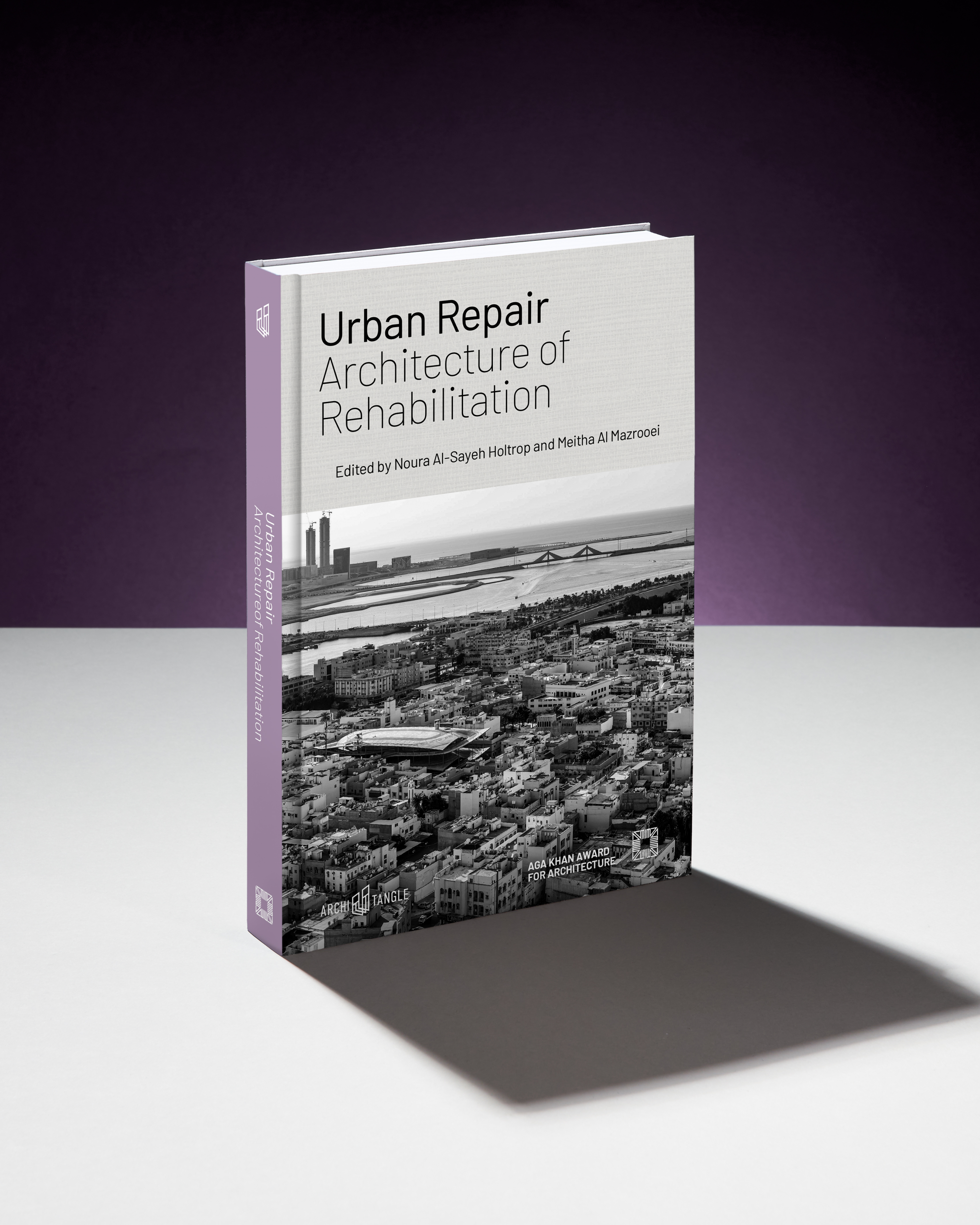
Urban Repair
Architecture of Rehabilitation
38,00 €
Edited by Noura Al-Sayeh Holtrop and Meitha Al Mazrooei
Description
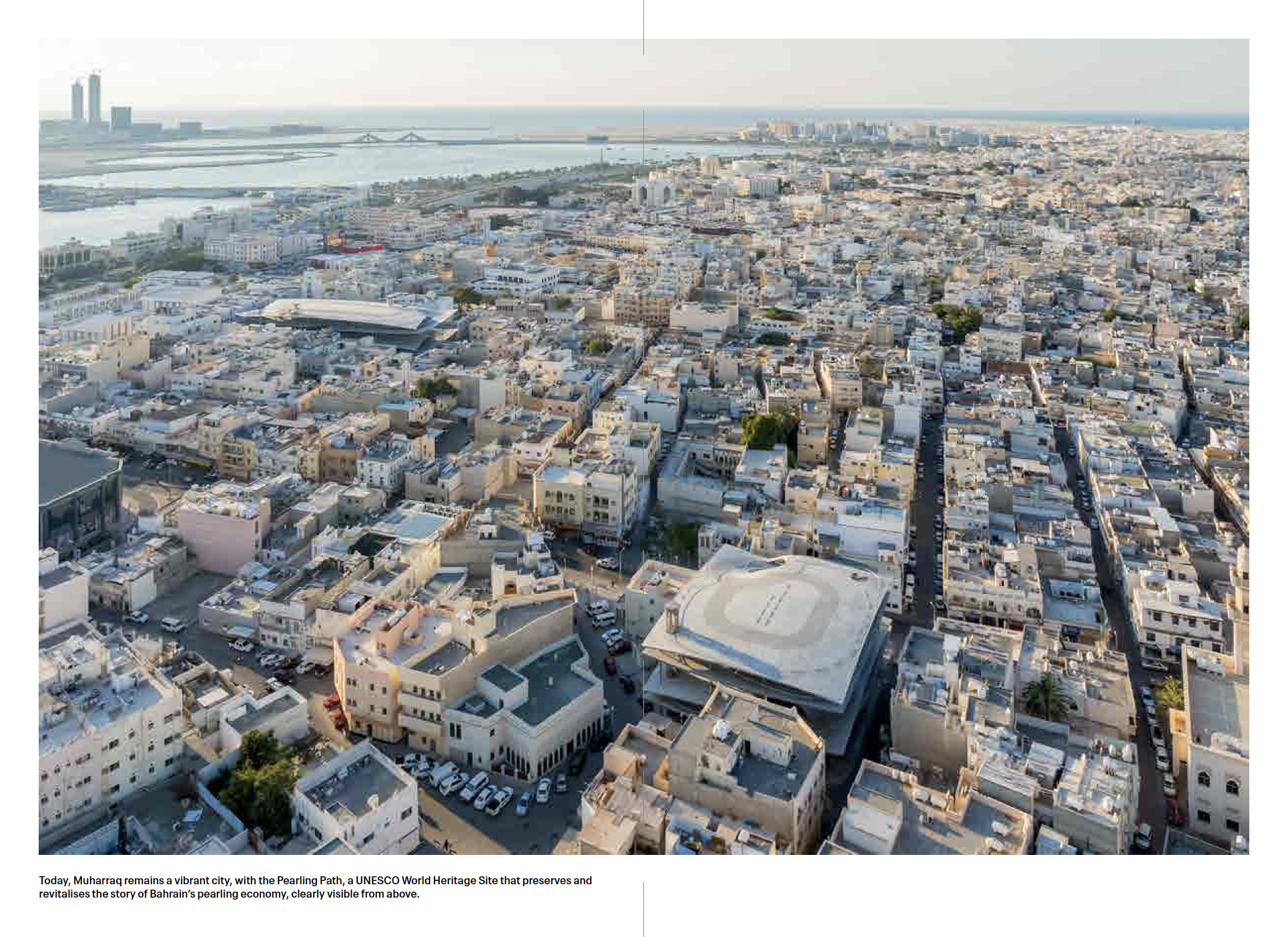
Urban Repair addresses a growing imperative in architectural scholarship and practice: how we rehabilitate, reintegrate, and remake built environments in ways that respect heritage while enabling contemporary life. This volume contributes to the evolving discourse on the responsibility for addressing concerns around social and spatial rehabilitation. It draws from the case of the Aga Khan Award for Architecture-winning Pearling Path site in Muharraq, Bahrain, while maintaining an eye toward broader methodological, cultural, and critical frameworks.
Contributions from various disciplines analyze how careful and bold interventions catalyze urban regeneration, and how integrating architectural conservation, urban planning, and cultural programming are essential ingredients for the rehabilitation of historic cities. They ask: What constitutes Urban Repair? How can local voices, community culture, institutional frameworks, and contemporary architecture align in a rehabilitation agenda that is neither nostalgic nor sterile, but generative and future-oriented? Thematically structured from historical background to architectural detail, this volume juxtaposes theoretical essays with applied interventions, enabling direct dialogue between academic reflection and built work.
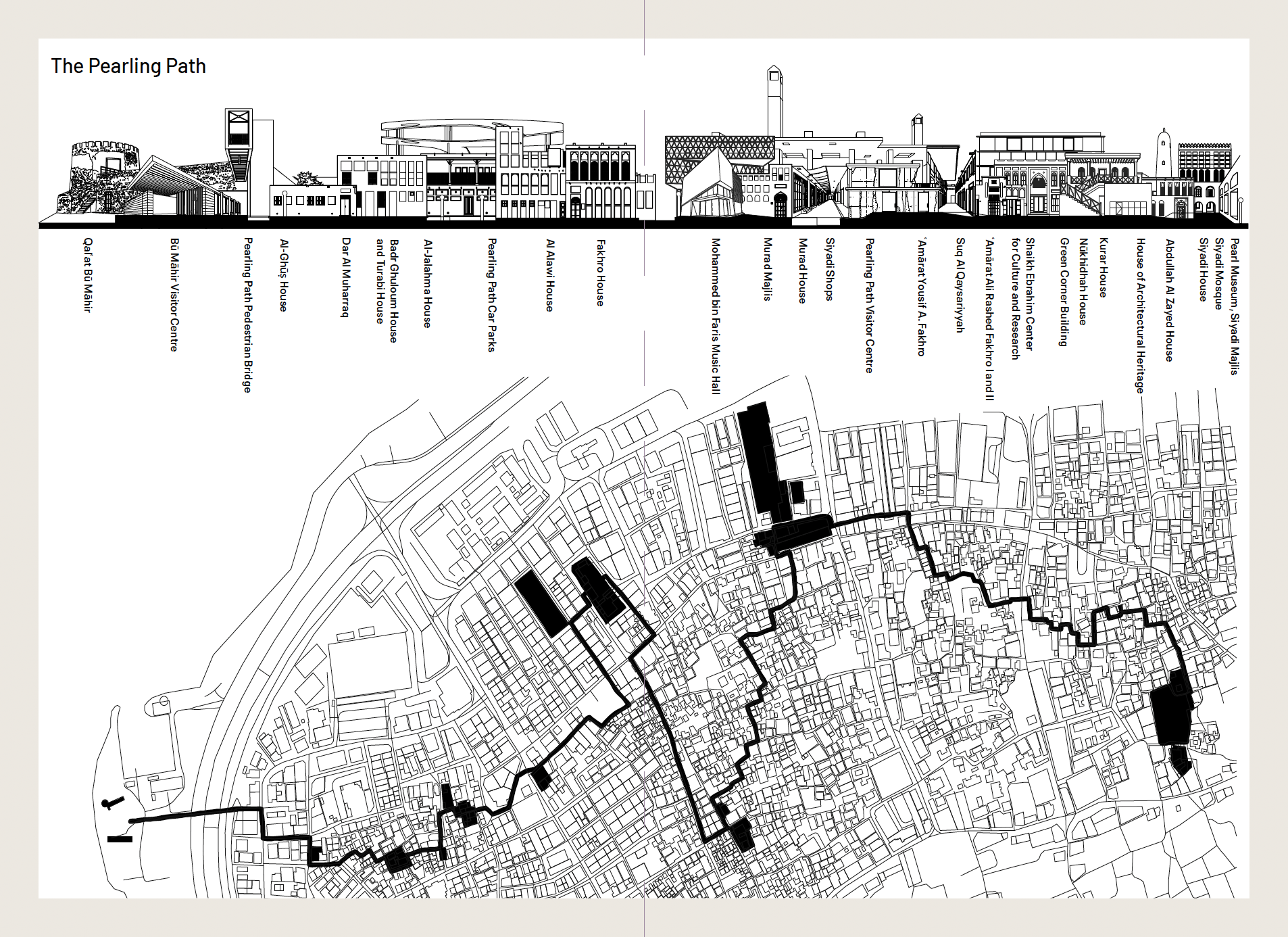
The volume also introduces the newly built Pearling Path projects by Valerio Olgiati (Pearling Path Visitor and Experience Center), Anne Holtrop (Suq Al Qayssareyah and exhibition buildings), and Christian Kerez (multi-story parking structures), along with collaborators such as Office Kersten Geers David Van Severen on public squares and pedestrian bridges. Their architectural gestures are layered in a process of repair and renewal, and they span urban, institutional, and community scales.
Urban Repair invites readers to see preservation not merely as an act of conservation, but as a form of critical inquiry—one that reveals and interprets the layered histories and memories embedded in a place’s material fabric. The project’s analysis explores how the preservation of the intangible—through the revival of traditional crafts and music—complements the conservation of the tangible. In doing so, it helps to reactivate the city’s social and economic life, ensuring that the project’s benefits remain rooted in the local community and become part of an ongoing, contemporary dialogue with history.
Details
| Weight | 755 g |
|---|---|
| Dimensions | 245 × 170 × 30 mm |
| Contributions by | H.E. Shaikha Mai bint Mohammed Al Khalifa, Rahel Aima, Nada Al Hassan, Shaikha Mariam bint Hisham Al Khalifa, Meitha Al Mazrooei, Noura Al-Sayeh Holtrop, Dalal Musaed Alsayer, Meisa Batayneh, Mounir Bouchenaki, Farrokh Derakhshani, Seif El Rashidi, Hasan Hujairi, Adrian Lahoud, Jala Makhzoumi, Hayfa Matar, Sarah A. Rifky, Nadia Siméon, and Shadia Touqan. |
| Art Director | Julia Wagner, grafikanstalt |
| Language | English |
| Features | Hardback, full color, stich bound, embossed |
| Size | 17 x 24,5 cm, 6.7 x 9.6 in |
| Illustrations | 193 illustrations |
| Page count | 304 pages |
| Publication Date | October 2026 |
| ISBN | 978-3-96680-043-3 |
Sicherheits- und Herstellerinformationen / Manufacturer and Safety Information
Hersteller/Manufacturer: ArchiTangle GmbH
Adresse/Address: Meierottostr. 1, 10719 Berlin, Germany
Email: gpsr@architangle.com
Contributions by
H.E. Shaikha Mai bint Mohammed Al Khalifa
Rahel Aima
Nada Al Hassan
Shaikha Mariam bint Hisham Al Khalifa
Meitha Al Mazrooei
Noura Al-Sayeh Holtrop
Dalal Musaed Alsayer
Meisa Batayneh
Mounir Bouchenaki
Farrokh Derakhshani
Seif El Rashidi
Hasan Hujairi
Adrian Lahoud
Jala Makhzoumi
Hayfa Matar
Sarah A. Rifky
Nadia Siméon
Shadia Touqan
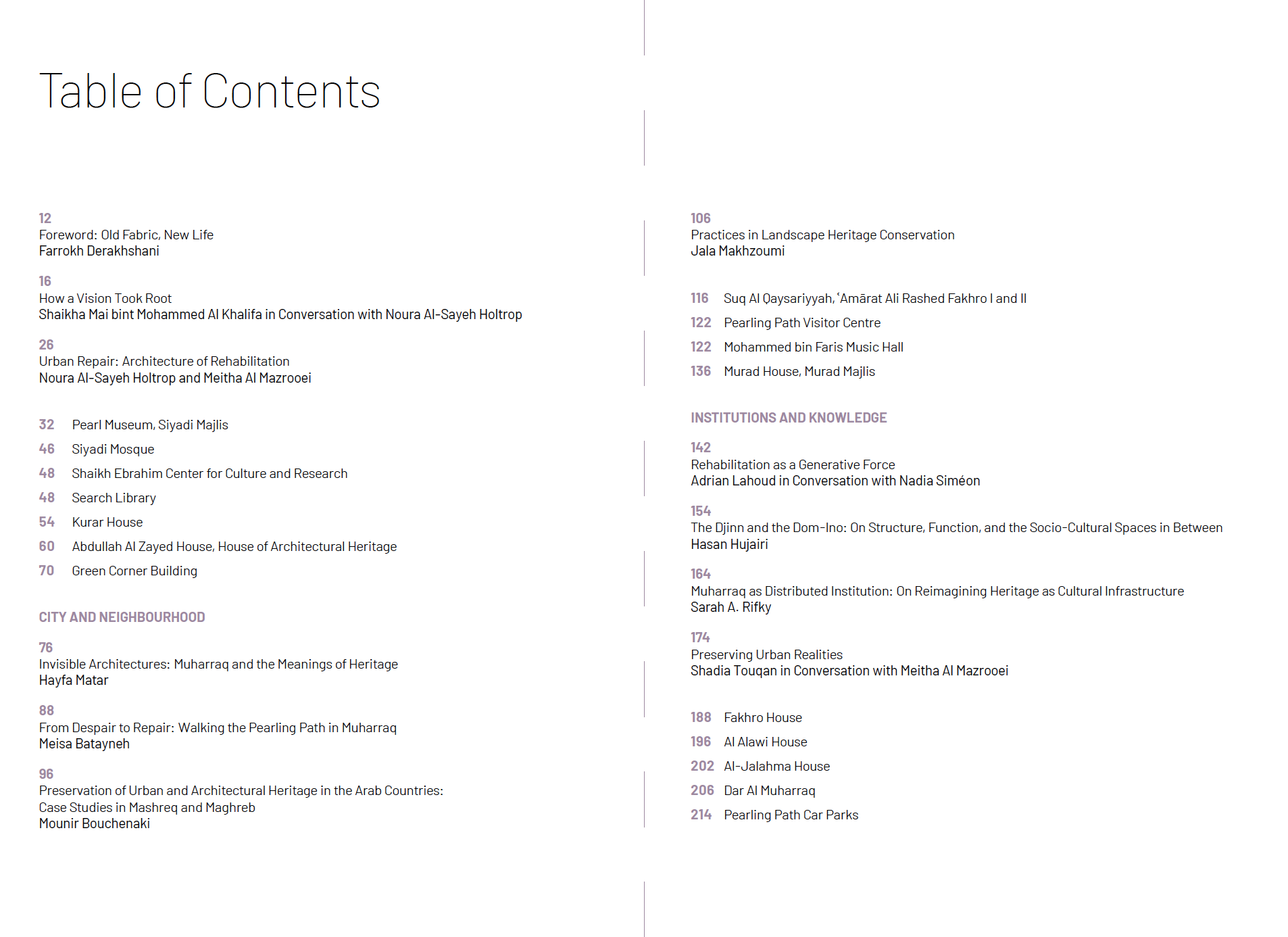
Table of Contents
Foreword: Old Fabric, New Life
Farrokh Derakhshani
How a Vision Took Root
Shaikha Mai bint Mohammed Al Khalifa in Conversation with Noura Al-Sayeh Holtrop
Urban Repair: Architecture of Rehabilitation
Noura Al-Sayeh Holtrop and Meitha Al Mazrooei
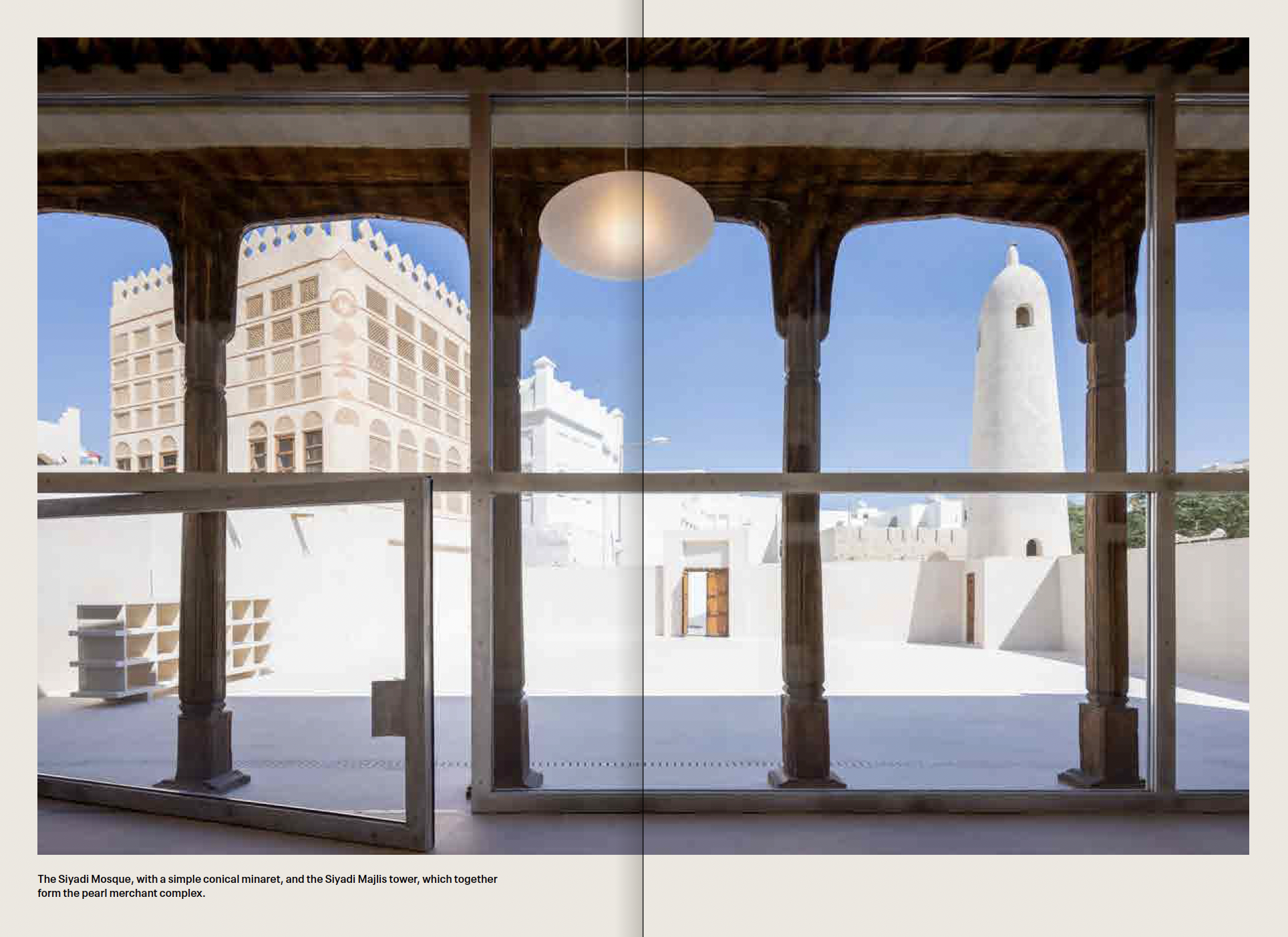
Pearl Museum, Siyadi Majlis
Siyadi Mosque
Shaikh Ebrahim Center for Culture and Research
Search Library
Kurar House
Abdullah Al Zayed House, House of Architectural Heritage
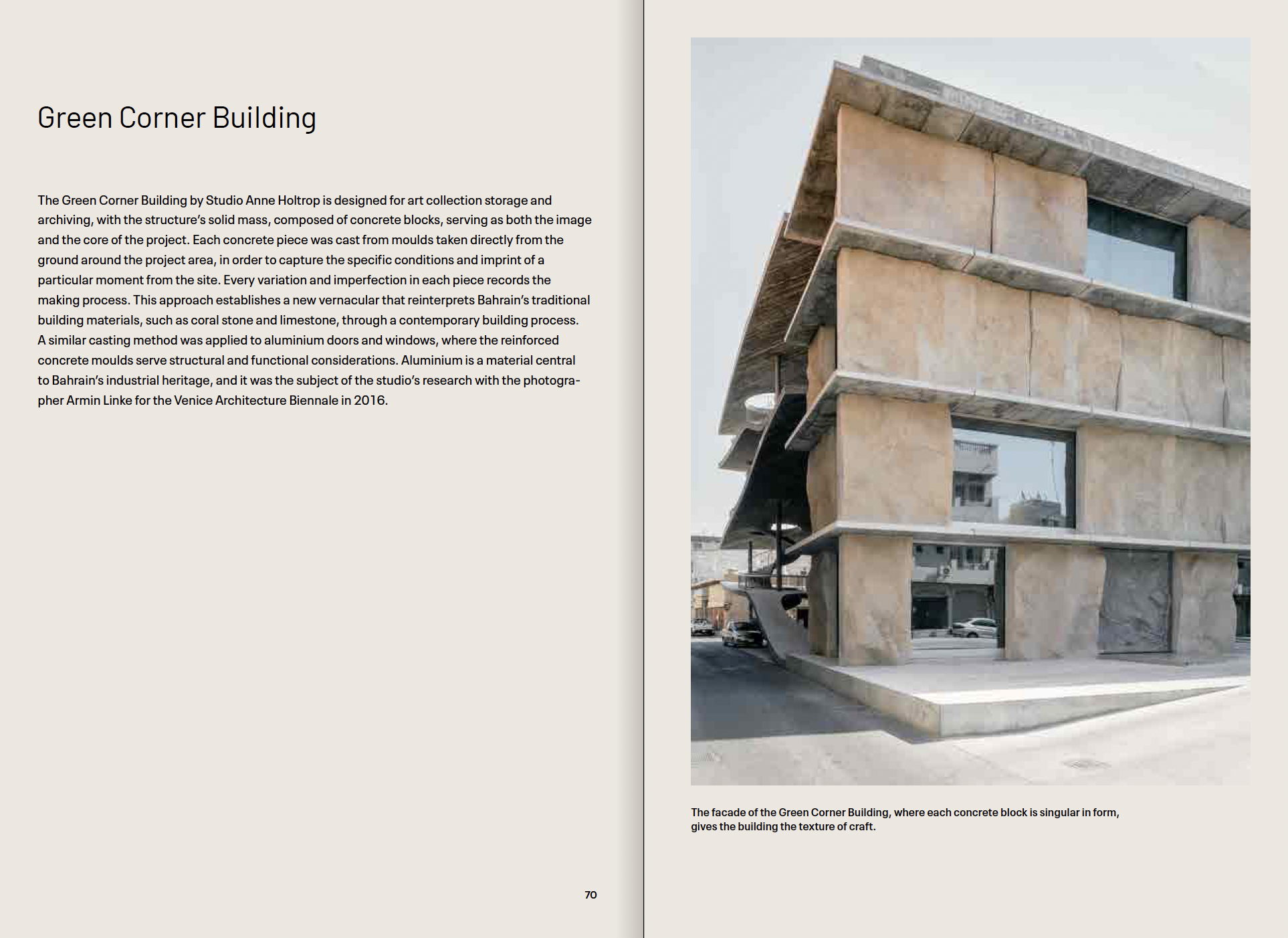
Green Corner Building
CITY AND NEIGHBOURHOOD
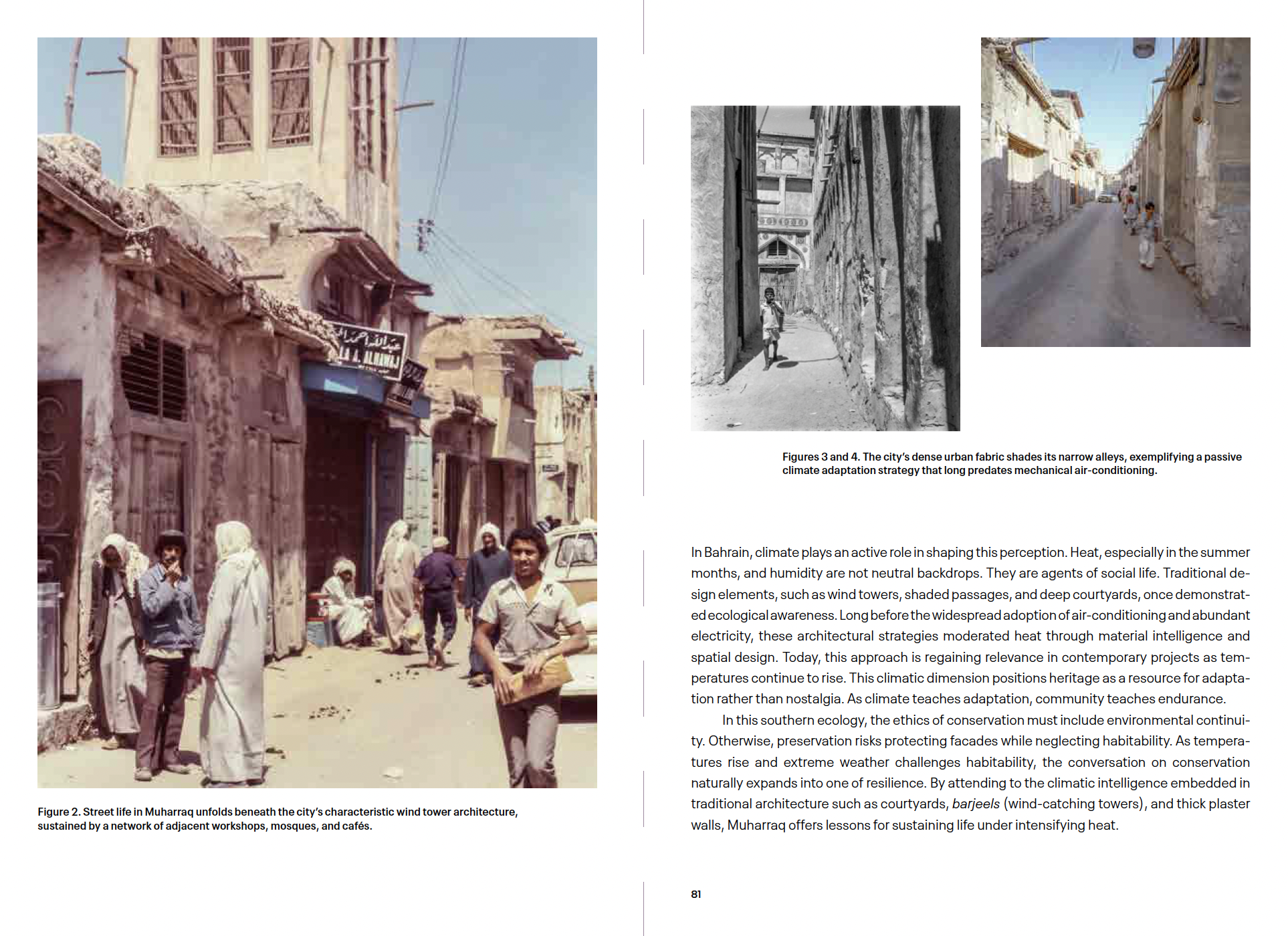
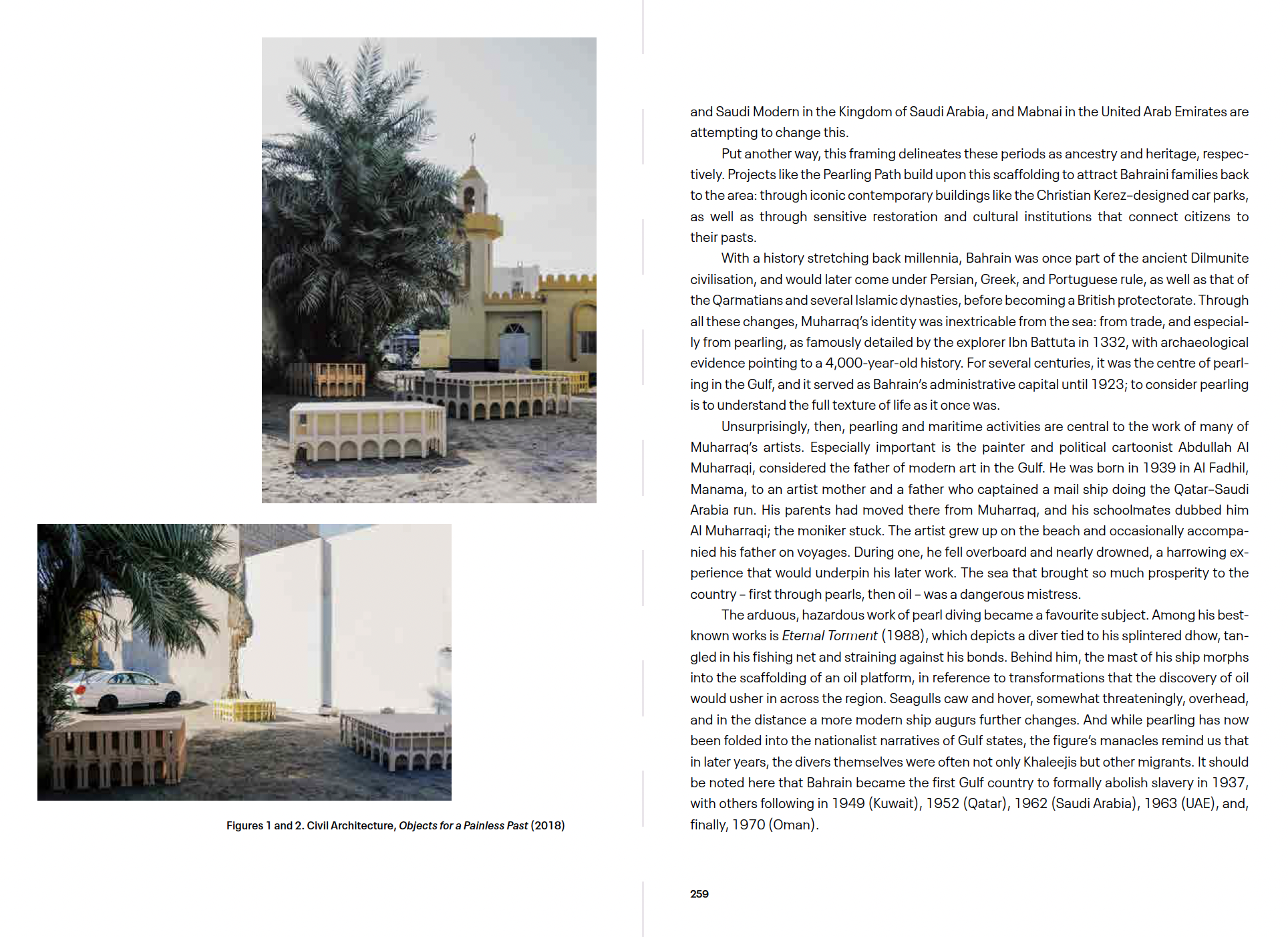
Invisible Architectures: Muharraq and the Meanings of Heritage
Hayfa Matar
From Despair to Repair: Walking the Pearling Path in Muharraq
Meisa Batayneh
Preservation of Urban and Architectural Heritage in the Arab Countries: Case Studies in Mashreq and Maghreb
Mounir Bouchenaki
Practices in Landscape Heritage Conservation
Jala Makhzoumi
Suq Al Qaysariyyah, ʿAmārat Ali Rashed Fakhro I and II
Pearling Path Visitor Centre
Mohammed bin Faris Music Hall
Murad House, Murad Majlis
INSTITUTIONS AND KNOWLEDGE
Rehabilitation as a Generative Force
Adrian Lahoud in Conversation with Nadia Siméon
The Djinn and the Dom-Ino: On Structure, Function, and the Socio-Cultural Spaces in Between
Hasan Hujairi
Muharraq as Distributed Institution: On Reimagining Heritage as Cultural Infrastructure
Sarah A. Rifky
Preserving Urban Realities
Shadia Touqan in Conversation with Meitha Al Mazrooei
Fakhro House
Al Alawi House
Al-Jalahma House
Dar Al Muharraq
Pearling Path Car Parks
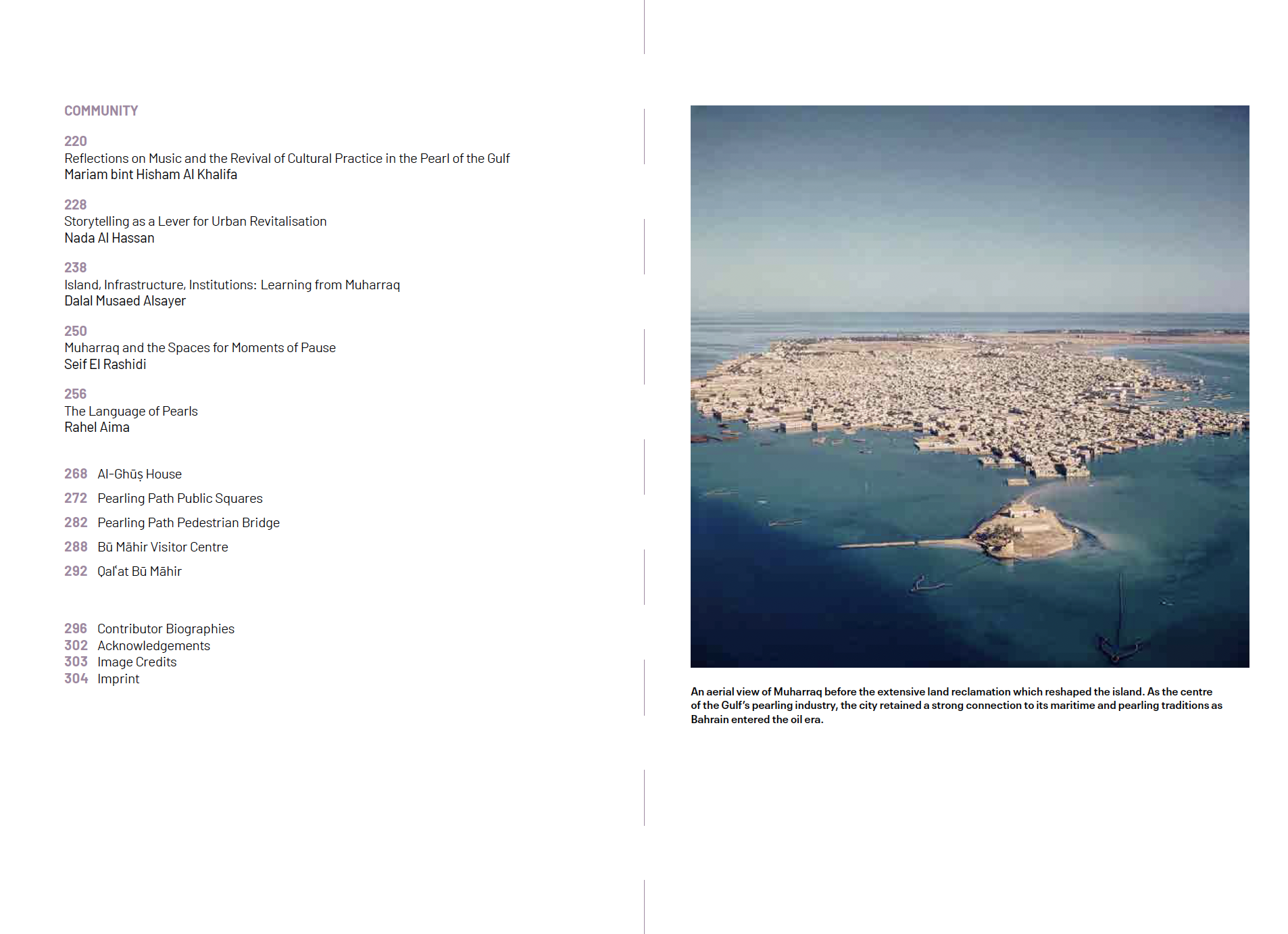
COMMUNITY
Reflections on Music and the Revival of Cultural Practice in the Pearl of the Gulf
Mariam bint Hisham Al Khalifa
Storytelling as a Lever for Urban Revitalisation
Nada Al Hassan
Island, Infrastructure, Institutions: Learning from Muharraq
Dalal Musaed Alsayer
Muharraq and the Spaces for Moments of Pause
Seif El Rashidi
The Language of Pearls
Rahel Aima
Al-Ghūṣ House
Pearling Path Public Squares
Pearling Path Pedestrian Bridge
Bū Māhir Visitor Centre
Qalʿat Bū Māhir
Author's Biographies
The Editors
Noura Al-Sayeh Holtrop is an architect and curator based in Bahrain and advisor for heritage projects at the Bahrain Authority for Culture and Antiquities (BACA), overseeing cultural institutions, museums, urban rehabilitation, and public spaces. Since 2015, she has led the UNESCO World Heritage project “Pearling, Testimony of an Island Economy,” awarded the Aga Khan Award for Architecture in 2019. She was an On-Site Reviewer in 2022 and a Master Jury member for the Award’s 2025 cycle. Al-Sayeh Holtrop co-curated Reclaim, Bahrain’s first participation at the Venice Architecture Biennale in 2010, which won the Golden Lion. In 2025, she was deputy commissioner for Heatwave, Bahrain’s National Pavilion at the Venice Architecture Biennale, which also received the Golden Lion. Moreover, she served as deputy commissioner general for the Bahrain Pavilion at Expo 2025 Osaka and is curator of Arab Design Now at Design Doha 2026.
Meitha Al Mazrooei completed her PhD in history, theory, and criticism of architecture at the Massachusetts Institute of Technology (2026) and holds an MS in critical, curatorial & conceptual practices in architecture from Columbia University’s GSAPP. Her curatorial and editorial work includes public programming for Guggenheim Abu Dhabi, publications for the National Pavilion UAE at the Venice Biennale, and establishing WTD Magazine, an architecture and design publication. Her recent editorial work includes the co-edited anthologies On Foraging: Food Knowledge and Environmental Imaginaries in the UAE’s Landscape and In Plain Sight: Scenes from Aridly Abundant Landscapes (both published by Kaph Books in 2023).
The Authors
Rahel Aima is a writer, editor, and strategist in Dubai, where she co-directs the Bayt Al Mamzar writing residency and is the editor of HORSE PAINTING, a journal of postwestern criticism. Her research focuses on the quantisation of heritage and the production of national identity across architecture, craft, and contemporary art. She is currently working on a collection of essays about the Khaleeji Ideology, terroir, and where oil meets water in the Gulf.
Nada Al Hassan is an architect specialising in the conservation of architectural and urban heritage. Her career in cultural heritage protection and management has spanned Europe, Africa, and the Arab States. She has led restoration and international cooperation projects for the United Nations Development Programme, the World Bank, the European Commission, and UNESCO, including heritage conservation under the Bethlehem 2000 Project, cultural tourism development in Syria, and UNESCO’s Aksum Obelisk Reinstallation Project in Ethiopia. From 2013 to 2018, she headed the Arab States Unit at the UNESCO World Heritage Centre and later served as Head of UN-Habitat’s Sub-Regional Office for the Maghreb and as Advisor for Culture to the Director-General of UNESCO. She served as a member of the 2022 Master Jury of the Aga Khan Award for Architecture.
H.E. Shaikha Mai bint Mohammed Al Khalifa is an influential international figure known for her work in the field of culture, art, and sustainable development. She was listed as one of the fifty most influential women in the Arab World by Forbes Magazine in 2005 and is the recipient of many distinguished awards. Acknowledging the power of culture as a driver of sustainable development, Al Khalifa has spearheaded innovative projects to develop infrastructure to deliver on the UN Sustainable Development Goals. She has served as the Minister of Culture of Bahrain, the president of the Bahrain Authority for Culture and Antiquities (BACA), and the chairperson of the board of the Arab Regional Centre for World Heritage. She is the founder of the Shaikh Ebrahim bin Mohammed Al Khalifa Center for Culture and Research. Under her leadership, the Bahrain Authority for Culture and Antiquities has significantly enhanced the preservation and establishment of sites that promote heritage tourism: three of these sites are now on the World Heritage List.
Shaikha Mariam bint Hisham Al Khalifa is a Bahraini cultural researcher and writer with a specialisation in traditional fashion and crafts. Her work explores themes of identity, heritage, and material culture. Mariam joined the Bahrain Authority for Culture and Antiquities (BACA) in 2012, where she worked on festivals, exhibitions, and event programming for the Bahrain National Theatre and Bahrain National Museum until 2015. She went on to collaborate with BACA on the Bahrain National Pavilions at Expo Milan 2015, Expo Dubai 2020, and Expo Osaka 2025. She is the author of Bahrain Crafts: Community, Collaboration & Cultural Heritage (Assouline, 2024).
Dalal Musaed Alsayer holds a PhD in architecture from the University of Pennsylvania and is an assistant professor of architecture at Kuwait University. Her research explores architecture, environment, and development in the twentieth-century Arab world. She co-edited Pan-Arab Modernism (Actar, 2021) and is developing a manuscript on US development programmes and their impact on Arabia’s urban fabric between 1949 and 1961. Her scholarship is supported by numerous grants from Harvard University, the University of Pennsylvania, and the Mellon Foundation, and she was a finalist for the WHA Dissertation Award. She holds degrees from Columbia, Harvard, and UPenn and was an academic visitor at the University of Oxford (2022–23).
Meisa Batayneh is an architect and the founder and principal at maisam architects & engineers, based in Amman, Jordan. Batayneh studied architecture at the University of Texas at Arlington, prior to leading multidisciplinary teams on large-scale international and regional projects in the United States, Pakistan, Cyprus, Saudi Arabia, Egypt, and the United Arab Emirates. Batayneh is a member of the advisory committees of the Jordanian Ministry of Environment, the Amman Commission, and the Architecture & Engineering Business Council. She is the chairperson of Design Jordan, president of Business & Professional Women of Amman (BPW-A), and vice president of the Jordan Federation for Business & Professional Women. She served as a member of the 2022 and 2025 Steering Committees of the Aga Khan Award for Architecture and as a member of the Master Jury in 2019. She was a member of the Global Holcim Awards jury (2015 and 2021), a member of the Holcim Awards jury for Middle East Africa (2017 and 2023), and she served as a member of the board of the Holcim Foundation for Sustainable Construction from 2020 to 2025.
Mounir Bouchenaki is an Algerian archaeologist. He holds a PhD in archaeology and ancient history from the Arts Faculty of Aix-Marseille Universit. in Aix-en-Provence, France. Bouchenaki was Director-General of ICCROM (International Centre for the Study of the Preservation and Restoration of Cultural Property) from 2005 to 2011, UNESCO’s Assistant Director General for Culture (2000–06), director of the World Heritage Centre (1998–2000), and director of UNESCO’s Cultural Heritage Division (1990–2000). In January 2011, he was named honorary special adviser of the UNESCO Director-General and of the ICCROM Director-General. Bouchenaki has been awarded the titles of Chevalier des Arts et des Lettres and Officier des Arts et des Lettres by the French Ministry of Culture, and in 2002 he was raised to the rank of Commendatore of the Order of the Star of Italian Solidarity by the President of the Italian Republic. He was awarded the title Chevalier de la Légion d’Honneur by the President of the French Republic.
Farrokh Derakhshani is the director of the Aga Khan Award for Architecture and has been associated with the Award since 1982. Derakhshani trained as an architect and planner at the National University of Iran and later continued his studies at the School of Architecture in Paris (UP1). His main field of specialisation is the contemporary architecture of Muslim societies. Derakhshani lectures widely; has organised, participated in, and juried numerous international seminars, exhibitions, colloquia, workshops, and competitions; and has collaborated on a large variety of architecture-related publications. He is an International Fellow of the Royal Institute of British Architects (IntFRIBA) and an Honorary Fellow of the Royal Architectural Institute of Canada (Hon. FRAIC).
Seif El Rashidi is an art historian specialised in heritage, craft, and urban conservation, with a strong focus on community engagement. He is currently the director of The Barakat Trust, an organisation that supports the preservation of the cultural heritage of the Islamic world. He was formerly the project manager of Layers of London (2016–20), developed by the Institute of Historical Research at the University of London; project manager at the Guildhall Library, London (2016–18); Magna Carta Programme Manager at Salisbury Cathedral (2014–16); the coordinator of Durham’s UNESCO World Heritage Site (2008–14); a team member of the Aga Khan Trust for Culture’s Darb Al-Ahmar Revitalisation Project in Cairo (1997–2008) and at Ahmad Hamid Architects (1995–97).
Hasan Hujairi is a composer, artist, cultural curator, and independent researcher from Bahrain working at the intersection of avant-garde music composition, art, and ethnomusicology. He completed his doctoral studies in music composition at Seoul National University. The core of his research practice centres on maritime music traditions of the Western Indian Ocean, examining how sonic heritage intersects with built environments and cultural exchange across coastal regions. His research also encompasses the history of outsider composers and the role of sound and music as frameworks within historiography. Integrating curation, performance, and archival study, Hujairi crafts projects that reframe historical narratives through a distinct sonic lens.
Adrian Lahoud is an architect, urban designer, and researcher. He holds a PhD from the University of Technology Sydney and is professor of architecture and urban design at the Royal College of Art, London, and project director for the college’s work with Riyadh University of Arts (RUA). From 2016 to 2026, he served as dean of the School of Architecture at the Royal College of Art. Lahoud was studio master in the Projective Cities programme at the Architectural Association, London, and director of the MA in Research Architecture at Goldsmiths, University of London. In 2019, Lahoud curated the inaugural Sharjah Architecture Triennial, Rights of Future Generations. His work has been presented in exhibitions such as Let’s Talk about the Weather: Art and Ecology in a Time of Crisis at the Sursock Museum, Beirut (2016), After Belonging, Oslo Architecture Triennale (2016), and Forensis: The Architecture of Public Truth at Haus der Kulturen der Welt, Berlin (2014).
Jala Makhzoumi holds a PhD in landscape architecture from the University of Sheffield. She is the 2021 laureate of the Sir Geoffrey Jellicoe Award bestowed by the International Federation of Landscape Architects, and the recipient of the 2019 Lifetime Achievement Award by the European Council of Landscape Architecture Schools. Makhzoumi is an adjunct professor of landscape architecture at the American University of Beirut. She has worked on landscape planning for major urban development projects in Damascus, Saida, and Baghdad and co-founded the design and planning practice UNIT44. In practice, teaching, and research, she pioneers ecological design and planning, with a focus on community-inclusive approaches to landscape heritage conservation, post-war recovery, and sustainable urban greening. Her most recent publication is the co-authored volume Landscape Architecture in the Arab Middle East (Routledge, 2025).
Hayfa Matar is a Bahraini policy and strategy advisor based in Abu Dhabi. A former diplomat with more than twenty years’ experience across diplomacy, international affairs, and strategic advisory, she writes on culture, geopolitics, and heritage in the Gulf. Her work explores the relationship between heritage, urban life, and public policy, and the ways in which place, memory, and culture shape contemporary societies.
Sarah A. Rifky is an art historian, curator, and writer with a PhD in history and theory of art from the Massachusetts Institute of Technology. Her scholarship focuses on modern and contemporary art in Egypt and the Arab world, alongside comparative modernisms across the global majority. She currently contributes to the Musée d’Art et de Culture Soufis MTO in Chatou, Como Museum of Art in Lahore, and Zamaniyyat at Art Dubai, and serves as a contributing editor at Mada Masr. She is the founding co-director of the art institution Beirut in Cairo and has held curatorial roles at dOCUMENTA 13 and as senior curator and director of programmes at the Institute for Contemporary Art at Virginia Commonwealth University.
Nadia Siméon is deputy director of the Aga Khan Award for Architecture and an art historian and museologist trained at the École du Louvre. Associated with the Award since 2005, she was appointed deputy director in 2023. She oversees its procedures, from project nominations to the preparation of materials on Award recipients and Award ceremonies. Together with her team, she manages the collection, production, dissemination, and archiving of the Award’s extensive documentation, making use of evolving technologies. She also contributes to the organisation of international events and exhibitions, as well as to all Award publications. Siméon is also specialized in the concept of “New Museology”, a discourse on the social and political roles of museums which encourages different approaches to sharing knowledge, contrasting with the classic and traditional collections-centred museum model. She worked in France in various museums and set up several exhibitions related to contemporary art and architecture.
Shadia Touqan is a Palestinian-British-Jordanian architect and urban designer based in Sweden, holding a PhD in urban planning and development from University College London. With practice across the UK and Arab countries, she specialises in urban renewal, historic city revitalisation, and post-conflict reconstruction. As director of the Old City of Jerusalem Revitalisation Programme (1997–2014), she led the award-winning effort that earned the Aga Khan Award for Architecture in 2004. She later served as director of the Arab Regional Centre for World Heritage and as a World Heritage Committee member. A published scholar and Taawon board member, she continues championing heritage protection worldwide.
Shipping
Quick and affordable delivery cost for this product:
| Germany: | Free |
| Europe (EU): | EUR 8,90 per order (or free on any order of 2+ books) |
| Europe (Non-EU): | EUR 13,90 per order |
| World: | EUR 18,90 for this item |